
Traveling internationally with your hair dryer requires one critical step before you plug in. A dual voltage hair dryer gives you the freedom to style your hair anywhere in the world, but only if you switch the voltage correctly. How to switch voltage on a hair dryer is a straightforward process that takes just a few seconds, yet skipping this step can fry the motor, melt internal components, or create a fire hazard.
This guide walks you through every critical step: where to find the switch, how to set it safely, what tools you might need, and why proper voltage switching matters. You’ll also learn how to avoid common mistakes, choose the right plug adapter, and maintain your dryer for long-term global use.
Locate the Voltage Switch on Your Hair Dryer
The voltage switch is typically found near the base, handle, or cord entry point of the dryer. Look for a small slider or toggle marked with voltage indicators such as “125V / 250V,” “120V / 240V,” or an arrow pointing to either setting. Some models recess the switch or protect it with a small cover to prevent accidental changes during travel.
Check Common Switch Locations
Most dual voltage hair dryers place the switch in one of these three locations. Check the area where the cord meets the handle first, as this is the most common placement. The switch may be labeled with clear voltage numbers or use color coding where one side represents lower voltage and the other represents higher voltage.
Use a Tool If Necessary
Some models require a small screwdriver or paperclip to flip the switch. This safety feature ensures the setting doesn’t change accidentally during travel. Gently insert the tool and slide the switch to your desired voltage. Never force it if it feels stuck, as misalignment can damage the mechanism.
Set the Correct Voltage for Your Travel Destination
Always set the voltage before plugging in. Here’s a quick reference for common destinations.
| Region | Voltage Setting |
|---|---|
| USA, Canada, Mexico, Japan | 120V (or 125V) |
| UK, Germany, France, Italy, Australia, India | 240V (or 250V) |
| Brazil (varies by city) | Check locally first |
Match Local Power Standards
Research your destination’s voltage before traveling. Most countries outside North America operate on 220V to 250V systems, while the United States, Canada, Japan, and Mexico use 110V to 120V. Setting your dryer to 250V and using it in a 120V country will result in poor performance, while the reverse can cause permanent damage.
Don’t Assume Dual Voltage Means Auto-Sensing
Many travelers assume dual voltage means automatic adjustment. This is a dangerous misconception. Most dual voltage hair dryers require manual switching. You must physically change the switch position to match your destination’s voltage before each use. One user warned that forgetting to switch back after international travel is one of the most common ways people damage their dryers.
Unplug Before Switching: Critical Safety Step
Never attempt to change the voltage switch while the dryer is plugged in. Even a brief surge can damage the internal circuitry. Follow these safety steps every time you need to adjust the voltage setting.
The Safe Switching Procedure
First, unplug the dryer from the wall outlet. Wait 30 seconds for any residual power to dissipate. Then, flip the switch to your desired voltage. Finally, recheck the setting before plugging in at your destination. If the dryer is hot or was recently used, let it cool down first. Heat combined with electrical work creates unnecessary risk.
Use a Plug Adapter, Not a Voltage Converter

Understanding the difference between these two accessories is essential for safe international use. A plug adapter changes only the physical plug shape to fit foreign outlets. This is all you need for a dual voltage hair dryer. A voltage converter or transformer changes the electrical output itself and is not required for dual voltage models.
Choose the Right Adapter by Country
| Country | Plug Type | Adapter Needed |
|---|---|---|
| Italy, France, Spain | Type C | Type C adapter |
| UK | Type G | Type G adapter |
| Australia | Type I | Type I adapter |
| USA | Type A/B | Not needed at home |
Pack a universal travel adapter with built-in surge protection for added safety when visiting multiple countries. This simple tool ensures your dryer plugs in securely regardless of the local outlet type.
How the Internal Circuit Works When You Switch
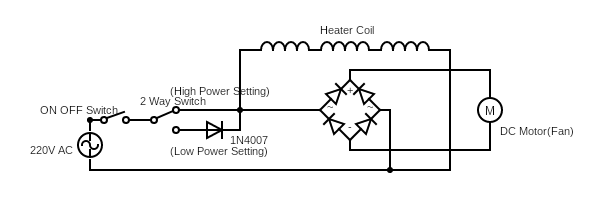
Understanding what happens inside your dryer when you flip the switch helps explain why this step is so important. The voltage switch changes how electricity flows through the heating element and motor.
Dual Coils Configuration
At 240V, the internal coils are wired in series, creating higher resistance that safely handles the increased voltage. At 120V, the coils switch to parallel wiring, reducing resistance and allowing more current to flow safely. This design maintains consistent power output around 1200W across both voltage settings.
Center-Tapped Heating Element
Some models use a center-tapped heating element design. At 240V, current runs through the full coil. At 125V, current runs from the center tap to one end, effectively halving the resistance to match the lower voltage requirements. This allows efficient operation without overheating regardless of which voltage setting you use.
Common Mistakes to Avoid When Traveling
Forgetting to Switch Back Home
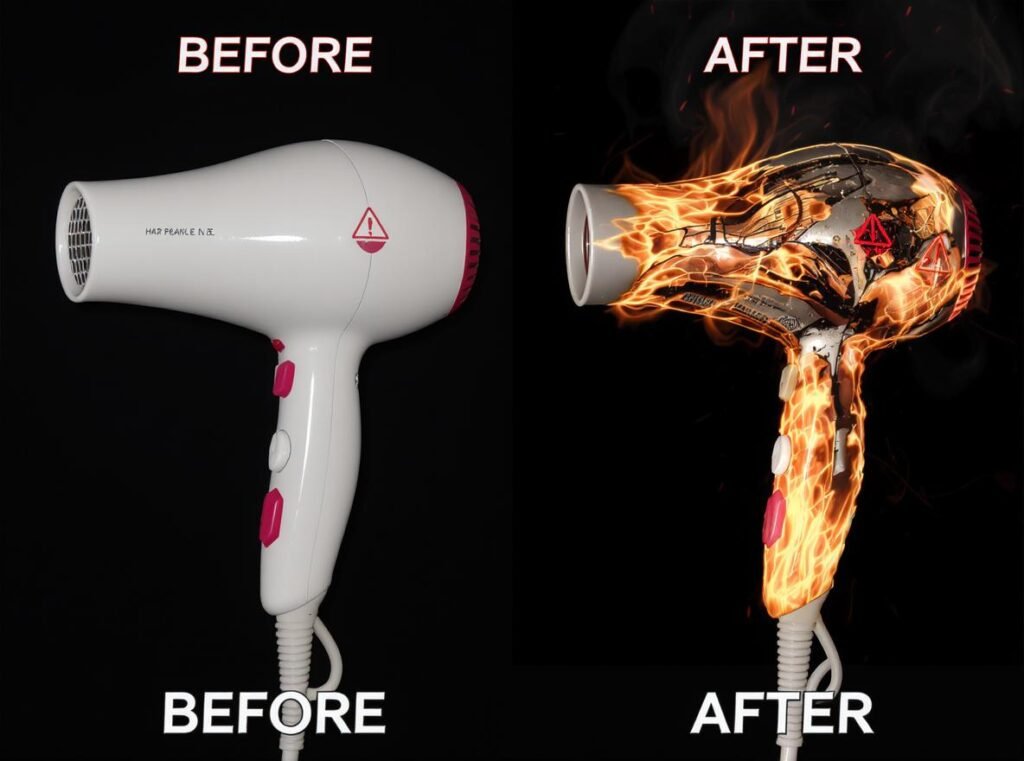
One of the most common errors is leaving the dryer set to 250V after returning from Europe. Plugging it into a 120V outlet in this configuration can cause the dryer to run weakly, overheat trying to compensate, or eventually fail entirely. Label the 120V setting with a small sticker if you travel often.
Using Without Verifying Specs
Not all travel dryers are dual voltage. Check the label for “125V~60Hz / 240V~50Hz,” the words “dual voltage” or “worldwide voltage,” or a manual switch symbol. If your dryer only says “120V,” do not use it overseas without a full voltage converter.
Assuming All Hotels Provide Good Dryers
Cruise ships and hotel bathrooms often have low-wattage units under 1000W, short cords, no concentrator nozzle, and fixed heat settings. A personal dual voltage dryer offers higher heat and airflow, better styling control, and compatibility with drying brushes.
What to Do If You Use the Wrong Voltage Setting
If you accidentally power on a hair dryer with the wrong voltage setting, unplug it immediately if you notice loud screeching or buzzing, a burning smell, smoke or unusual heat, or sparks at the handle or cord. These signs indicate severe electrical stress, and continued use risks permanent damage or fire.
Can It Be Fixed
In some cases, a blown thermal fuse or tripped safety cut-off may be replaceable. However, internal coil burnout usually means the unit is beyond repair. Prevention through proper voltage switching is always better than trying to fix damage afterward.
Maintaining Your Dual Voltage Hair Dryer for Long-Term Use
Label and Track Settings
If you travel frequently between regions, add a color-coded sticker to your dryer. Use red for 250V and blue for 120V. Keep a travel log note on your phone and store the dryer with the switch set to 120V if you are based in North America. This reduces the risk of misconfiguration.
Inspect the Switch Regularly
Over time, the switch mechanism can wear out or collect dust. Every few months, check for smooth operation and clean around the switch with compressed air. Ensure it clicks firmly into place. A loose or wobbly switch may fail mid-use.
Store Properly
Coil the cord loosely and keep the dryer in a dry, cool place. Avoid dropping it, as impact can misalign internal components and affect the voltage switching mechanism.
Frequently Asked Questions About Switching Voltage on Hair Dryers
Do all hair dryers have a voltage switch?
No, only dual voltage hair dryers have a voltage switch. Standard hair dryers designed for a single voltage will display only one voltage rating on the label. These require a full voltage converter for international use.
Can I use a voltage converter instead of switching the voltage?
No, using a voltage converter with a dual voltage dryer set to the wrong voltage can still cause damage. The converter changes the output, but if your dryer is set to 250V and you plug it into 120V with a converter, problems can still occur. Simply switch the voltage and use a plug adapter.
What happens if I forget to switch the voltage?
If you set your dryer to 120V and plug it into a 240V outlet, the dryer will likely run at full power immediately, potentially overheat, emit a loud noise, smoke, or fail completely. Conversely, setting it to 250V and using it in a 120V country results in weak airflow and poor performance.
How do I know if my hair dryer is dual voltage?
Check the label or rating sticker on the dryer. Dual voltage models will display two voltage ratings such as “125V~60Hz / 240V~50Hz” or clearly state “dual voltage” or “worldwide voltage.” If only one voltage is listed, it is not dual voltage.
Do I need a special adapter for every country?
Yes, you need a plug adapter that matches the outlet type of your destination country. Common types include Type C for most European countries, Type G for the UK, and Type I for Australia. A universal travel adapter covers most outlet types.
Can I use my dual voltage hair dryer on a cruise ship?
Yes, but with caution. Cruise ship outlets typically run on 110V to 120V, similar to US outlets. Set your dryer to 120V. However, cruise ship staterooms often have low-wattage dryers built into the bathroom, so bringing your own ensures better performance.
Key Takeaways for Safe Voltage Switching on Your Hair Dryer
Following these essential steps ensures safe operation anywhere in the world. Always unplug completely before touching the switch. Locate the switch near the base or handle of your dryer. Set it to match local voltage, using 120V for North America and 250V for Europe and most other countries. Use only a plug adapter, never a voltage converter. Test briefly on first use in a new country and stop immediately if you notice unusual noise or heat. Finally, switch back to your home voltage after travel to avoid damaging your dryer when you return.
By following these guidelines, you’ll keep your hair dryer running safely and efficiently across continents. How to switch voltage on a hair dryer isn’t complicated, but it’s critical. Get it right, and you’ll enjoy salon-quality results wherever your travels take you.