

You’ve shaped your polymer clay masterpiece, but you don’t have access to an oven. Maybe you’re in a dorm, traveling, or just hoping for a quick fix, so you grab a hair dryer and start blasting heat. Sound familiar? While it might seem like a clever workaround, using a hair dryer to dry or cure polymer clay won’t work and could ruin your project.
Polymer clay isn’t like air dry clay. It doesn’t harden at room temperature. Instead, it needs consistent high heat between 265°F and 275°F for 15 to 30 minutes to fully cure. This process called polymerization fuses the PVC particles inside the clay into a strong, flexible solid. Hair dryers typically max out around 140°F, over 125°F too low, so they cannot trigger this chemical change.
Why Hair Dryers Fail to Cure Polymer Clay
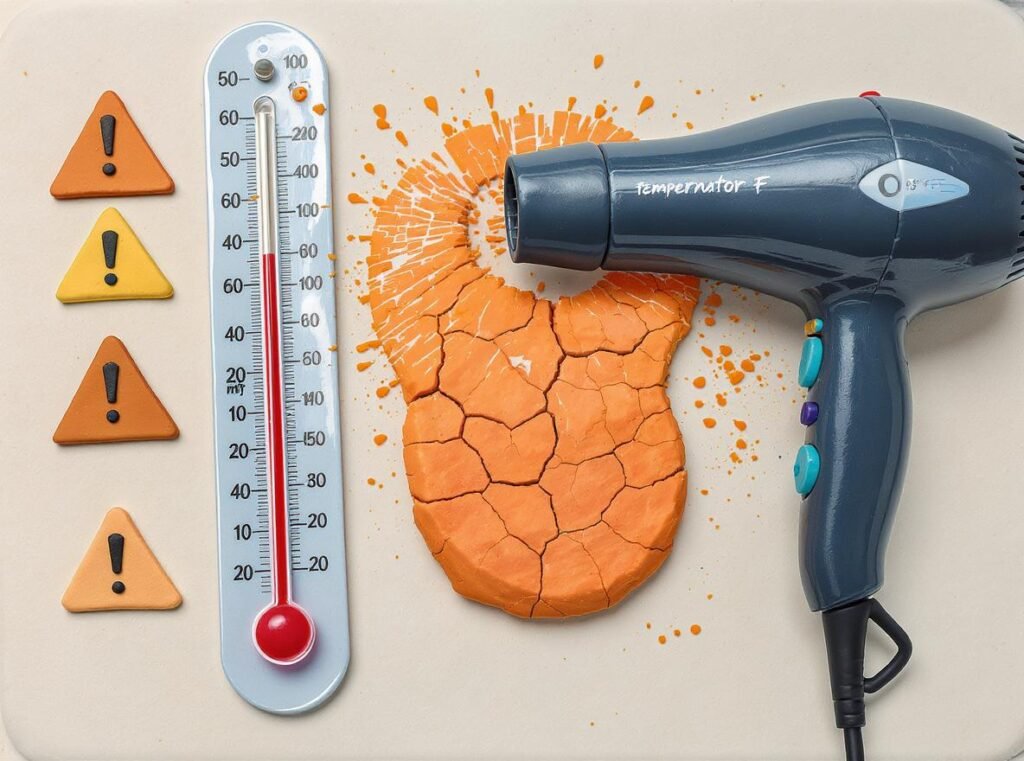
Temperature Gap: 140°F vs. 275°F
The core issue is simple: hair dryers do not get hot enough. Most models reach only 120 to 140°F, while polymer clay requires at least 265°F to begin curing. Even professional grade dryers fall short of this threshold.
Without reaching the minimum temperature, the clay’s internal structure never changes. You’re not baking. It’s like trying to cook a cake with a fan heater. The outside might feel warm, but nothing inside is done.
As one experienced crafter noted, polymer clay needs to be heated to approximately 275°F to cure. Hair dryers do not reach anywhere near this temperature. No amount of airflow or time can close this gap.
Heat Penetration Is Shallow and Uneven
Hair dryers use convective heat, meaning they blow warm air over a surface. This type of heat does not penetrate deeply into thick clay. It creates hot spots on the surface while leaving the interior cool and uncured.
This leads to false curing, a hard outer shell with a soft, gummy center. If you press on the piece, it may dent or collapse. Over time, it can crack, warp, or even crumble.
One user testing Fimo clay with a hair dryer found the piece remained soft throughout and slipped off the work surface during heating. This proves the method is unreliable.
No Time-Temperature Control
Proper curing requires both correct temperature and sufficient time. For every quarter inch of thickness, polymer clay needs 15 to 30 minutes at full heat.
Hair dryers lack thermostats or timers. You cannot maintain a steady temperature, and manually holding the dryer leads to inconsistent exposure. Some areas get too much heat, others get none.
Without control, you risk under-curing, surface scorching, and wasted effort and materials.
Limited Safe Uses for Hair Dryers
Soften Stiff Clay Before Sculpting
While hair dryers cannot cure clay, they can help condition stiff polymer clay, especially brands like Papa’s Clay that are hard at room temperature.
Use low to medium heat and keep the dryer 6 to 8 inches away from the clay. Move it constantly in circular motions for 10 to 20 seconds. The warmth makes the clay more pliable and easier to blend or shape.
Warning: Never overheat. If the clay feels hot to the touch or starts to stick, stop immediately. Over-softening can cause oil separation or damage.
Dry Paint or Sealant on Cured Pieces
After baking, you might paint or seal your polymer clay with water based products. A hair dryer can speed up drying of acrylic paints, water based varnishes, and liquid coatings.
Use cool or low heat settings and keep the dryer moving. Avoid prolonged exposure, which can warp or discolor the surface.
This is only safe on fully cured clay, not raw or partially baked pieces.
Warm Tools or Work Surfaces
Cold hands or a chilly workspace can make polymer clay harder to work with. A quick blast from a hair dryer can warm metal tools like blades or cutters, loosen stuck rollers on a pasta machine, and heat a ceramic tile work surface slightly.
Again, use brief, indirect heat. Never apply direct, sustained airflow to raw clay with the goal of curing.
Why Ovens Are the Only Real Solution
Required Conditions for Proper Curing
To fully cure polymer clay, you need temperature between 265 and 275°F depending on brand, time of 15 to 30 minutes per quarter inch thickness, even heat distribution, and stable sustained heat.
Only ovens can reliably deliver all four. They surround the clay with consistent heat, allowing deep penetration and complete polymerization.
Best Oven Alternatives for Small Spaces
No full kitchen oven? No problem. Several compact options work perfectly.
Toaster Ovens are compact, affordable, and fast heating. They are ideal for dorms or small apartments. Use an oven thermometer to verify temperature and bake on a ceramic tile or parchment lined tray.
Air Fryers many double as mini convection ovens. They can maintain low curing temps set to 275°F. Monitor closely because small chambers heat unevenly. Leave the basket open slightly if needed for airflow.
Dedicated Craft Ovens are designed specifically for polymer clay. They offer precise temperature control and low risk of contaminating food ovens. They are slightly more expensive but worth it for frequent users.
Pro Tip: Always calibrate your oven with a standalone thermometer. Many run hotter or colder than the dial suggests.
Risks of Using a Hair Dryer for Curing
Electrical and Fire Hazards
Running a hair dryer continuously for 15 or more minutes increases risks of motor overheating, circuit overloads especially in older buildings, and fire hazard if left unattended or near flammable materials.
Never leave a hair dryer running while unattended. Use a GFCI protected outlet and keep a fire extinguisher nearby.
Fumes and Ventilation Issues
Even partial heating of polymer clay can release hydrochloric acid fumes if temperatures exceed 350°F, more likely with heat guns but possible with prolonged exposure.
Always cure in a well ventilated area. Open a window, use a fan to direct air away, and avoid breathing fumes directly. Never bake polymer clay in a microwave, hair dryer, or open flame.
Real User Experiences: What Happens in Practice
Dorm Student Test Case
A college student shared their struggle. Living in a dorm with no oven access, they tried using a hair dryer after previously using a small toaster oven. While thin pieces baked in 4 to 7 minutes survived a cross-country move and a fall from a shelf, the community cautioned that short baking times do not guarantee full curing.
Thicker or load bearing pieces may fail later, even if they seem fine at first.
Community Verdict: Overwhelming No
Across Reddit and crafting forums, the consensus is clear. Users responded with simple “no” answers and warnings about brittleness. One user stated items will be too brittle. Another noted it will never be even and you cannot ensure it gets to the right temperature.
Even experimenters agree, the risks outweigh the convenience.
Best Alternatives If You Cannot Use an Oven

Switch to Air Dry Clay
If baking is not possible, air dry clay is your best bet. Options include cold porcelain also known as flower clay, strong and smooth and dries in 24 to 48 hours, paper based air dry clays that are lightweight and easy to sand, and eco friendly blends that are non-toxic with minimal shrinkage.
Advantages include no oven needed, safe for dorms, and child friendly. Drawbacks include less durable than baked polymer clay and requires sealing.
Try Epoxy Clay Instead
Two part epoxy clays like Apoxie Sculpt or Milliput cure through a chemical reaction, not heat.
They require no baking, fully harden in 4 to 24 hours, can be sanded, drilled, and painted, and are waterproof and weather resistant.
Great for sculptures, repairs, and outdoor art. Downsides include more expensive and longer wait time with limited working window.
Essential Tools for Proper Curing
Must Have Equipment
You need an oven thermometer to verify actual temperature since ovens often run inaccurate. Use a ceramic tile or glass dish as a baking surface to prevent scorching and retain heat. A timer prevents under or over baking. Parchment paper provides a non-stick layer and avoids direct contact with surfaces. Heat resistant gloves ensure safe handling when removing hot pieces.
Hair Dryer Specs for Conditioning Only
If using for softening clay, choose a model with 1600W or more power, 3 heat settings, 2 speed options, a concentrator nozzle for focused airflow, and overheat protection with a cool shot button.
Use only briefly and never for curing.
Performance Comparison: Hair Dryer vs. Real Methods

The hair dryer reaches approximately 140°F with poor temperature control and poor evenness. It produces surface only curing quality and carries fair safety risk from electrical issues. Its best use is conditioning and drying paint.
A toaster oven reaches 450°F or more with excellent temperature control and good evenness. It produces complete curing quality with high safety when contained. Best use is for dorms and small spaces.
An air fryer reaches 400°F or more with good temperature control and good evenness with monitoring. It produces complete curing quality with moderate safety. Best use is alternative baking.
A convection oven reaches 500°F or more with excellent temperature control and excellent evenness. It produces professional results with high safety. Best use is for frequent bakers.
A heat gun reaches 500 to 1200°F with fair temperature control and poor evenness. It carries high burn risk. Best use is detail work, not curing.
Note: Heat guns are not recommended for curing either. They are too hot and uneven.
Final Verdict: Do Not Use a Hair Dryer to Cure Polymer Clay
Despite the temptation, a hair dryer cannot cure polymer clay. The science is clear. It is too cold at 140°F versus required 265°F or higher. It produces too uneven surface only heating. It is too unreliable with no temperature control.
You will end up with a brittle, fragile piece that may break months later, wasting time, effort, and materials.
What You Can Do with a Hair Dryer
You can soften stiff clay before sculpting, speed dry paint on cured pieces, and warm tools or work surfaces.
Recommended Solutions for No Oven Users
Consider using air dry clay such as cold porcelain, switching to epoxy clay, buying a mini toaster oven dorm-safe and under $30, or baking at a friend’s house or local craft studio.
For durable, long-lasting results, oven baking is the only reliable method. Skip the shortcuts. Your art deserves better.
Frequently Asked Questions About Drying Polymer Clay
Can a hair dryer harden polymer clay?
No. Hair dryers max out around 140°F, while polymer clay requires 265 to 275°F to cure. The lower temperature only hardens the surface temporarily without triggering the chemical polymerization needed for proper curing.
What happens if you use a hair dryer on polymer clay?
The surface may feel firm or dry, but the interior remains soft and under-cured. This creates a false curing effect where the piece looks done but is actually brittle and prone to cracking, warping, or collapsing over time.
How long does it take to cure polymer clay properly?
Polymer clay needs 15 to 30 minutes at 265 to 275°F for every quarter inch of thickness. Thicker pieces require longer baking times to ensure the heat penetrates and cures the center completely.
What can I use instead of an oven for polymer clay?
Toaster ovens, air fryers, and dedicated craft ovens all work as alternatives to full size ovens. You can also switch to air dry clay or epoxy clay if baking is not possible at all.
Is there any safe way to use a hair dryer with polymer clay?
Yes. Hair dryers can safely soften stiff clay before sculpting, dry paint or sealant on already cured pieces, and warm tools or work surfaces. Never use a hair dryer as a curing method.


